
Criminal Court Cases in Columbia County
The Columbia County Clerk of Circuit Court keeps the official file from its first filing through the end of the retention period. Wisconsin Circuit Court handles the county's felony, misdemeanor, and criminal traffic cases in Branches I, II, and III. Julie Kayartz is the clerk and legal custodian. Her office is at the Columbia County Courthouse, 400 DeWitt Street, P.O. Box 587, Portage, Wisconsin 53901, and the main clerk line is 608-742-9625.
City municipal courts are separate. They hear local ordinance and traffic forfeiture matters, which generally are not Wisconsin crimes. A municipal result therefore does not replace a Columbia County Circuit Court search. The event location and filing court control venue, not merely a person's home address. That point matters in Columbus, which crosses Columbia and Dodge Counties.
Columbia Court Branches at DeWitt
All three circuit branches sit at the DeWitt Street courthouse. The branch and judge appear in the WCCA header, along with the county, filing date, status, and case number. Those details help distinguish two similar names. They also tell the clerk which file to retrieve. Court staff maintain minutes, calendars, judgments, and CCAP entries, but the clerk expressly cannot give legal advice.
The county's criminal process also spans another building. A detained defendant may appear by video from the jail at 403 Jackson Street while observers attend at the courthouse. The video link is a hearing method, not a separate case record. Docket events and filed documents remain with the circuit clerk.
Columbia County Case Record Searches
Wisconsin Circuit Court Access, often called WCCA or CCAP, provides free public circuit case information after the user accepts its terms. It is a public case-information service, not a certified criminal-history product. Use the criminal case-type filter because the same index includes civil, family, traffic, and forfeiture matters.
- Accept WCCA's use and accuracy notice, then choose a party-name or case-number search.
- Enter the strongest identifiers available. A middle name and birth date can narrow a common name.
- Select Columbia County and filter to CF, CM, or CT when the filing location is known.
- Open the case details and read every count, event, disposition, judgment, and sentence entry.
- Ask the circuit clerk to inspect or copy the official file when a needed document is unavailable online.
The Wisconsin court search gateway links the public circuit and appellate systems.
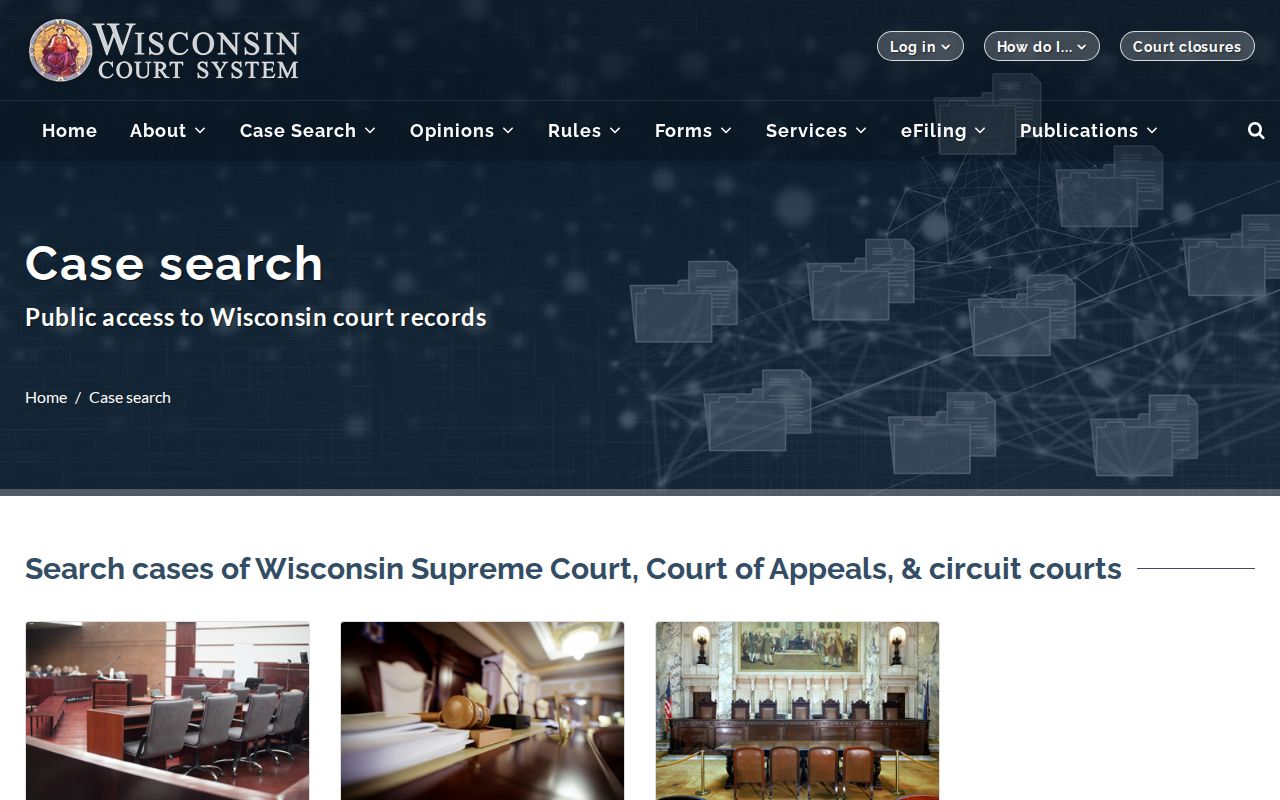
The gateway helps route a circuit filing to WCCA and an appeal to the separate appellate record system.
| Field | Type | Required | Use |
|---|---|---|---|
| Last name | Text | Yes for name search | Required name locator |
| First or middle name | Text | Optional | Narrows similar names |
| Birth date | Date | Optional | Identity aid when displayed data permit comparison |
| Case number | Text | Conditional | Direct route to a known file |
| County | Dropdown | Optional | Select Columbia or search statewide |
| Case type | Dropdown | Optional | Choose CF, CM, or CT for criminal matters |
| Filed date range | Dates | Optional | Narrows results by year |
Reading Columbia WCCA Case Codes
Wisconsin case numbers pair a filing year, a case-type code, and a sequence. CF means criminal felony. CM means criminal misdemeanor. CT means criminal traffic. The code describes the court file, not the final outcome. A CF case can contain dismissed counts, amended charges, or a conviction on fewer counts than were first filed.
- Initial appearance
- The court gives charge information and addresses counsel and release conditions. It is not a guilt finding.
- Preliminary hearing
- A felony-stage probable-cause hearing, or a hearing the defendant may waive.
- Arraignment
- The stage at which a plea is entered.
- Amended judgment
- A later judgment entry that supersedes the earlier detail it changes.
- Notice of appeal
- A sign that the next record layer may be in Wisconsin appellate case access.
The Wisconsin court system's CCAP overview explains how clerks, eFiling, and court data exchange connect.
That data path explains why WCCA has procedural depth while the clerk still holds the official record.
Financial and bond entries need the same care as charge codes. A displayed balance can combine court costs, surcharges, restitution, and other assessments. It is not a bond figure. Cash or signature bond can also carry nonfinancial conditions that remain important after money is posted. Court staff can identify a docket entry or explain how to obtain a public document, but they cannot interpret the order as legal advice. When an entry is unclear, compare it with the signed judgment or bond order instead of drawing a conclusion from the short docket label.
What a Criminal Case File Contains
A Columbia County criminal file follows prosecution rather than jail intake. Its strongest value is count-by-count context. The complaint shows what prosecutors filed, while later entries can show a plea, dismissal, trial result, sentence, or amended judgment. A financial balance may combine costs, surcharges, restitution, or other parts. It is not automatically a bond amount.
| Header | Columbia County, case number, caption, filing date, status, branch, and judge. |
|---|---|
| Parties | Displayed defendant name, counsel, prosecutor, and limited identifying data. |
| Charges | Count, statute, description, class, offense date, plea, and final disposition. |
| Bond | Cash or signature bond, conditions, amount, and status when public. |
| Docket | Complaint, appearances, hearings, motions, warrants, judgment, and appeal notices. |
| Sentence | Confinement, jail credit, probation or extended supervision, conditions, fines, and costs. |
| Documents | Descriptions of filings; remote document access varies. |
When Columbia Court PDFs Stop
WCCA does not promise remote access to every underlying document. If a docket entry is visible but its PDF is not, note the exact Columbia County case number and contact the clerk. A courthouse public-access terminal may show nonconfidential county documents that are not available from home. Ask whether inspection is possible before ordering copies, and distinguish a plain copy from a certified copy.
The research found no current Columbia County certified-copy price in official sources. Ask the clerk for the current amount instead of relying on another county's schedule. Confidential cases, expunged records, victim-sensitive information, protected identifiers, and sealed documents will not become public just because someone visits the counter.
The Wisconsin appellate document search is the official next layer when a notice of appeal appears.
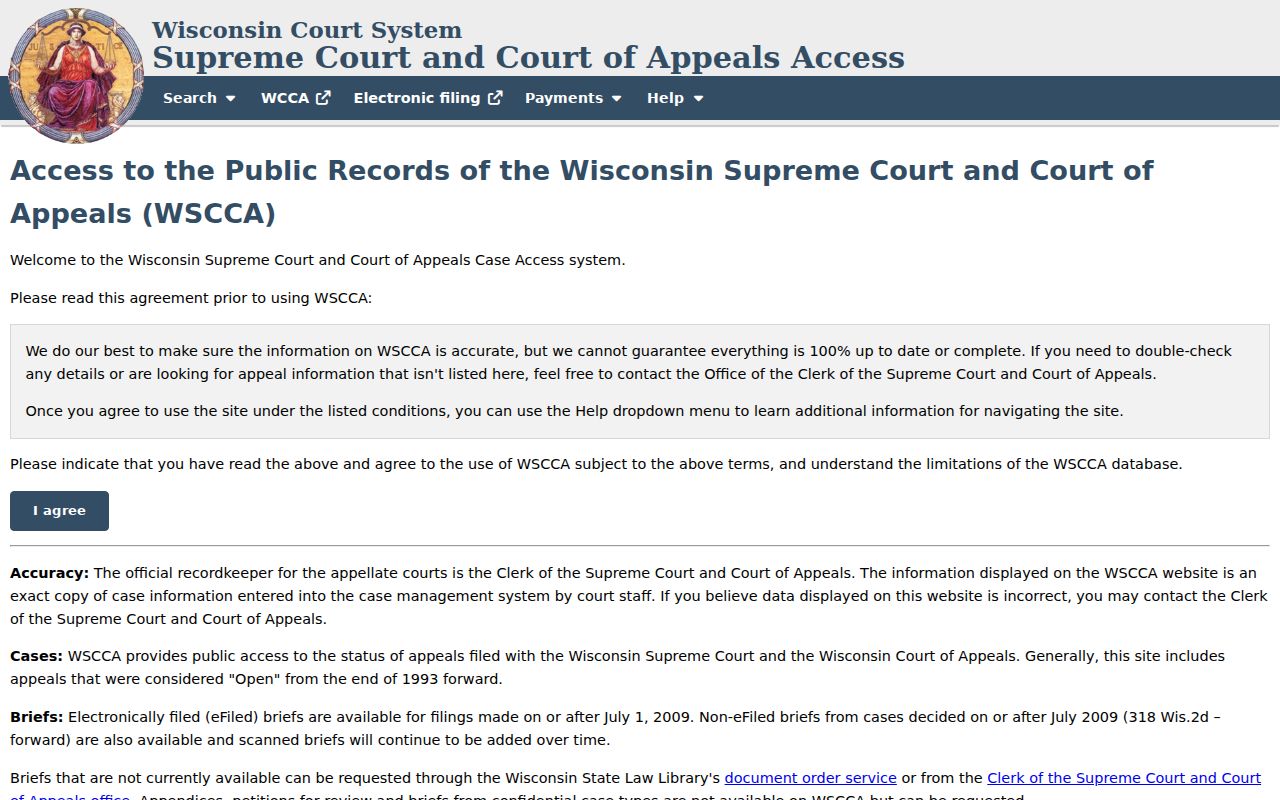
An appeal creates a separate appellate trail while the Columbia County circuit file remains the trial-court source.
Criminal Case Stages in Columbia County
Law enforcement first refers a report to the Columbia County District Attorney. The prosecutor may decline, change, or file charges. Filing opens the WCCA case. At the initial appearance, the court addresses notice, counsel, bond, and conditions. A felony can move through a preliminary hearing or waiver before arraignment. Motions are requests until the court rules on them. A plea, trial, dismissal, or deferred prosecution outcome can resolve individual counts.
Case flow: Charges Filed › Arraignment › Pretrial › Plea or Trial › Disposition › Sentencing
A judgment is the key conviction and sentence record. CCAP then sends closed-case disposition and sentence data electronically to Wisconsin DOJ's Crime Information Bureau. Timing or matching gaps can cause a court result and a state repository response to differ for a time.
Columbia Deferred Prosecution Records
The Columbia County District Attorney's criminal process page describes deferred prosecution as a consent-based diversion option. It may be offered before or after filing, often to a person without a prior record who accepts responsibility and agrees to a contract. Terms can include classes, restitution, community service, or counseling.
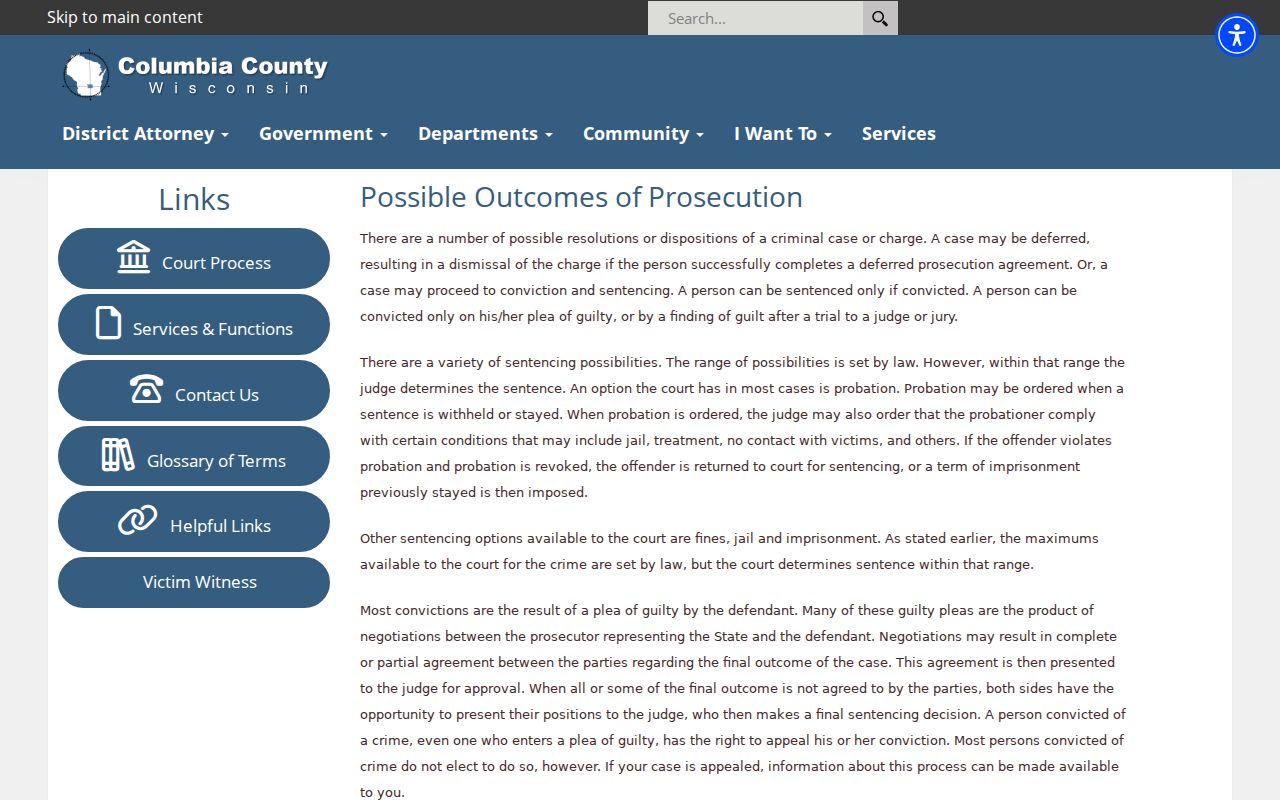
The local process source shows why a filed case can later end in dismissal without every program detail becoming part of the public docket.
Successful completion leads to dismissal. A violation or later criminal conduct can return the matter for prosecution. Readers should inspect each count's final disposition instead of assuming that a closed case means conviction. Booking charges can also differ from filed charges, since jail intake occurs before the prosecutor's charging decision.
Columbia Dockets Versus CIB Records
WCCA and the Wisconsin DOJ Centralized Criminal History database answer different questions. WCCA shows public court procedure, including pending and dismissed matters. A WORCS response compiles fingerprint-supported statewide arrest and disposition cycles. An event without usable fingerprints, or a disposition that cannot be matched to its arrest, may be absent from CIB. Neither source should be treated as a substitute for the other during a review of one's own record.
If WCCA is wrong, start with the circuit clerk. If a CIB disposition is missing or mismatched, gather the certified judgment and use DOJ's challenge process. The sheriff cannot change a court judgment, and the clerk cannot rewrite an arresting agency's narrative. The custodian of the erroneous record must handle its correction.
Access Rules for Case Records
Wisconsin Public Records Law favors public access, yet it does not make every court attachment downloadable. Juvenile matters, expunged cases, confidential reports, protected identifiers, victim-sensitive facts, and sealed filings may be restricted. WCCA also warns that similar-name results can occur and that the clerk's file is the official record.
Expungement under Wis. Stat. § 973.015 is generally decided at sentencing for eligible matters. It can remove the circuit record from public access after successful completion, but it is not a declaration of innocence and does not automatically erase every agency record. The Wisconsin criminal forms catalog includes CR-266 for qualifying non-probation and non-incarceration cases.
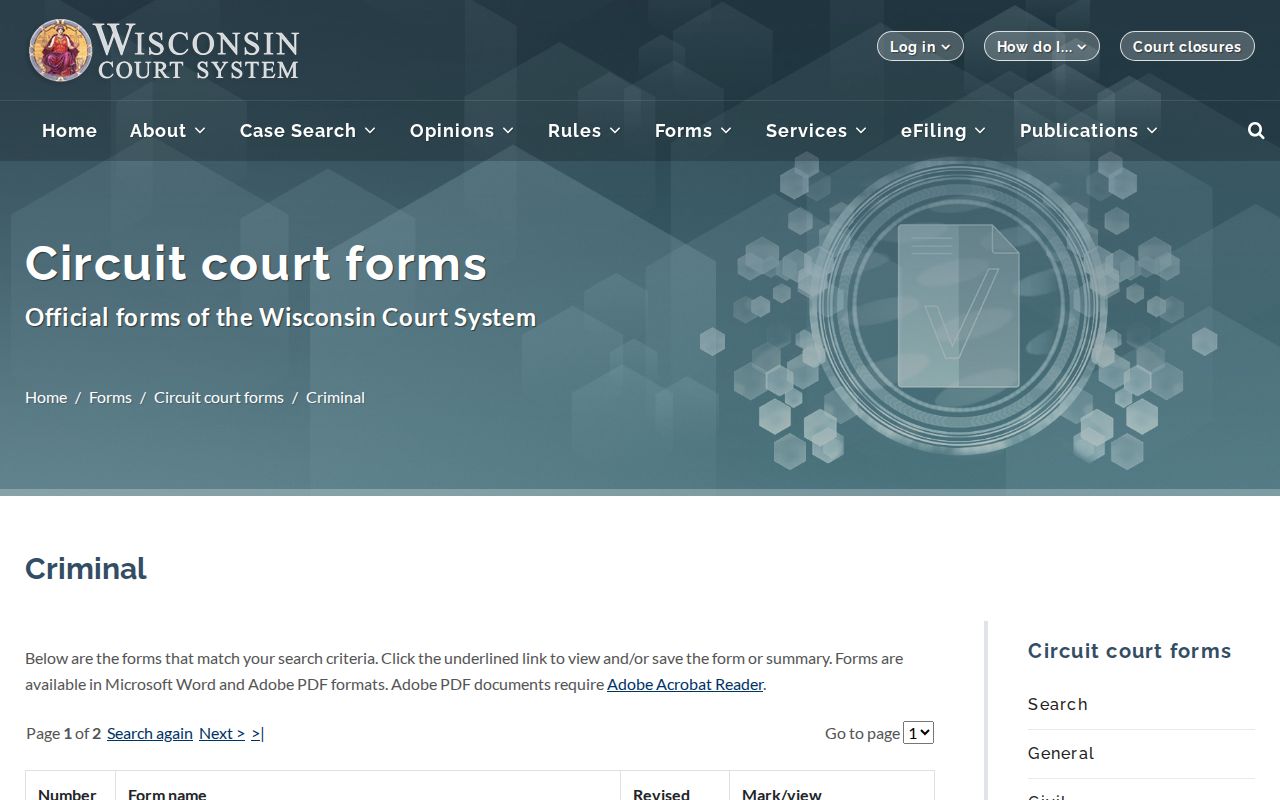
The form source supports a targeted filing inquiry, while eligibility and timing still depend on the statute and the sentencing record.